Detective Little
The Woman in the WindowDetective Little is the investigator who moves between two competing explanations of Anna Fox’s claims: that she has mistaken or imagined events, and that the Russell household conceals a real crime. His measured questioning initially helps close down her account, but later evidence reverses that judgment. His arc makes him an important figure in the novel’s contest over credibility: he has the authority to investigate, yet his conclusions depend on what can be corroborated and on which witnesses are believed.
Identity and Introduction
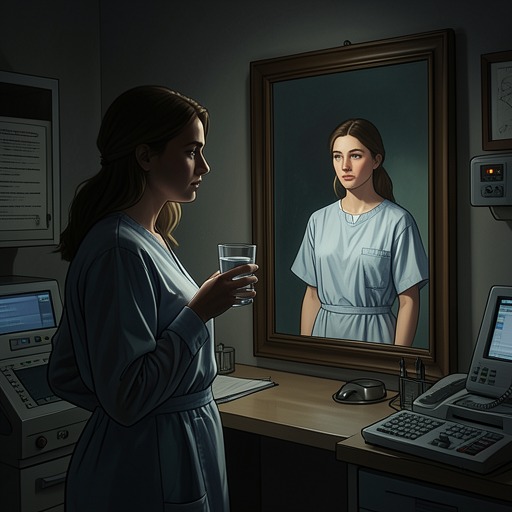
Detective Little first appears at Morningside Hospital, where Anna Fox wakes after being taken there the previous night. She is still affected by drugs and struggles to orient herself. Little identifies himself, checks whether she can understand the people around her, and asks for her name. Once she gives her surname, he consults his notepad and asks where she lives and where she was found. The encounter is procedural, but its circumstances matter: Anna is disoriented, while the police have already been waiting for her to regain consciousness.
The account gives Little an imposing physical presence, but his manner is deliberate rather than forceful. He speaks slowly and later uses the same controlled pace when he addresses Anna at home. That steadiness can register as patience; in the later confrontation, however, it also makes his dismissal of her claims difficult to resist. He is not simply a questioner in the background. His interpretation helps determine whether Anna’s observations will be treated as evidence or as symptoms of an unreliable perception.
Investigation and Evidence
Little’s investigation includes checking the people and circumstances that might confirm Anna’s movements. When he learns that someone photographed Anna while she slept and emailed the image to her, he asks whether anyone can confirm that she was in Connecticut the previous night. David answers that the woman he was with might do so. Little’s question redirects attention from the disturbing photograph itself to a testable part of Anna’s account: where she was and who could verify it.
The investigation also exposes how fragile the evidence surrounding the Russell home has been. After a reported disturbance, police went to the house the next day, but the parents denied that anything had happened. As Ethan later explains to Anna, once her report was identified as the source, the dispute became her word against theirs; no one else had seen the woman she described. David, who had spent four nights with her, had seen her, but that fact did not erase the earlier problem of corroboration. These circumstances help explain the evidentiary gap without establishing that Little personally conducted every interview or made every decision at the first visit.
A separate point of uncertainty arises over the photograph sent from a Gmail address. Val Norelli notes that the address presents a tracing problem, and Little explains that there is no way to trace the account. Norelli raises the possibility that Anna sent the image to herself. The exchange shows how a concrete object can fail to settle a question of authorship: the picture proves that Anna was photographed asleep, but, without a traceable sender, it does not by itself identify who took or sent it. Little’s skepticism is therefore presented through a mixture of investigative limits and increasingly consequential assumptions about Anna.
From Doubt to Confrontation
During the later encounter at Anna’s home, Little tells her that he spoke with Dr. Julian Fielding after their phone call. The consultation gives him information from Anna’s doctor, but the scene does not detail what the doctor told him. Little then interprets Anna’s belief that she met the woman next door alongside her continuing belief that she is speaking with Ed and Olivia. He tells her that what she is thinking is not real and urges her to let the matter go. Anna, already worn down by the confrontation, begins to accept his framing.
Little’s intervention is consequential because his reassurance is also a rejection of Anna’s account. He does not merely ask her to pause an investigation: he presents her perception as unreal and asks her to stop pursuing it. The scene places his authority against her uncertainty. Anna has no firm proof that can compel him to accept her version, while his calm, sympathetic manner makes the conclusion sound protective rather than punitive. The later revelation does not make every earlier question unreasonable, but it shows the cost of treating a distressed witness’s condition as sufficient grounds to dismiss what she reports.
After Val Norelli plays Anna’s 911 call, Norelli notes that the dispatcher stayed on the line for six minutes, until emergency medical personnel confirmed they had reached the scene. The call and its duration provide a record beyond Anna’s later recollection. Little is present during the investigation in which this evidence is considered, but the exchange underscores that the case contains material capable of being checked against her account. The recording does not, on its own, establish the full truth about the household; it does make the response to Anna’s report part of the evidentiary record rather than merely another disputed memory.
Role, Reversal, and Aftermath
When the confrontation reaches its conclusion, Little acknowledges that he is not qualified to handle what should happen next. He describes his responsibility as stopping the matter and making it safe for everyone, including Anna, and asks her to call Dr. Julian Fielding. After Val announces that Ed and Olivia are dead, Little encourages Anna to seek that support again. His concern for her is explicit, but it arrives within a conversation in which her account has already been treated as a belief she must relinquish.
The later events overturn the working conclusion that Anna’s report is unreal. After the police arrive and emergency medical personnel remove a body, Little visits Anna at home for a second time. He tells her that Alistair Russell has been arrested and charged as an accessory to murder, and that Alistair confessed immediately after learning what had happened to his son. Little says Alistair admitted the events had happened as Ethan described them. The formerly disputed account is thus supported by a confession, changing the meaning of the neighbors’ earlier denials and of Anna’s own insistence that something had happened.
Little also tells Anna that he learned the woman’s real name was Sue after interviewing the neighbors. His follow-up makes clear that the investigation has continued beyond the first dismissal, although the account does not specify when every interview occurred or what each neighbor said. He apologizes to Anna, and says that Val owes her an apology as well. Anna does not dispute him. The apology acknowledges the personal failure at the heart of the investigation: the police had treated her as an unreliable source before the concealed events were established.
Narrative Significance
Little is neither simply an antagonist nor an infallible corrective. He is a police officer trying to make a confused situation safe, but his judgments are shaped by Anna’s vulnerability and by the Russell family’s ability to deny what she says. His questions about location, witnesses, and the untraceable email show the practical demands of verification; his confident instruction that Anna let the matter go shows how easily those demands become premature certainty.
His return gives the story’s reversal an institutional dimension. Anna’s perception is not validated merely because she insists on it: the later account includes further investigation, Ethan’s testimony, and Alistair’s confession. Little’s apology marks the point at which police authority changes sides, from discouraging Anna’s claim to recognizing that she was telling the truth. Through him, the novel connects a private crisis of self-doubt to a broader question of who is believed when evidence is incomplete—and what it takes for an authority figure to revise a conclusion.